-
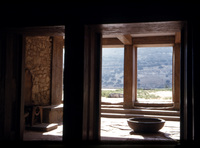
This image of the Throne Room at the ancient site of Knossos shows an interior space with stone walls, and floors, there are also beams holding up the roof and a large basin in the middle of the room. The space is open to the outside hilly terrain and also has benches along the walls and a throne.
-
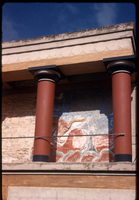
This image shows the Bull Fresco in the North Bastion of the ancient site of Knossos. This Fresco works in primary colors of red blue and yellow and depicts a bull with its horns down heading towards a tree. The horns of the bull especially stick out in the Fresco in a technique known as relief fresco. The Fresco itself is reconstructed and housed under a reconstructed porch with columns holding it up.
-
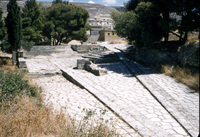
This is a view of the Royal Road leading to the Theatral Area at Knossos. The natural elevation is apparent through the leveling and building of pathways through the terrain. The Theatral Area lies at the end of the Royal Road (as seen in sackett_172) and shows the eastern flight of 18 stairs.
-
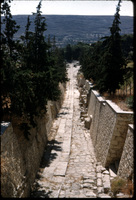
This is a view of a road which has a downward slope and looks out at hills in the distance. On each side of the road is distinguished sets of properties and stone walls. The Royal road leads to the Theatral Area of Knossos.
-
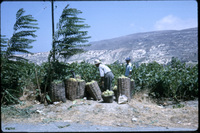
View of two men picking fruits along the side of a possible road, and collecting them in large wooden baskets. This image was taken from a taverna at Knossos.
-
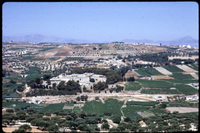
Landscape view of Knossos from far away including surrounding lands and farms
-
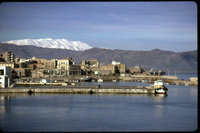
This is a view of the Heraklion port with a snowy mountain in the background.
-
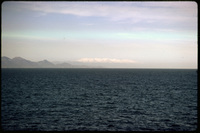
This is a view of Mt. Ida from a distance, with the Aegean Sea in the foreground.
-
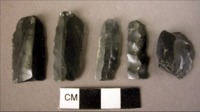
Chipped obsidian cores.
-
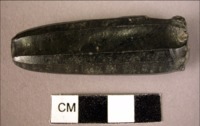
Obsidian prismatic core. Chipped stone. Measures 6.4 cm x 2.2 cm x 1.2 cm.
-
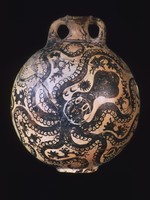
Marine-style pottery vessel with stylized octopus motif, from Palaikastro, Crete, ca. 1500-1450 BCE
-
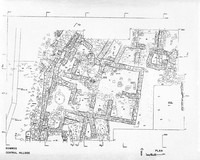
A drawing of a plan of Kommos from the view of the central hillside area.
-
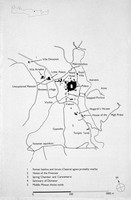
A map of the excavated and un-excavated structures found at Knossos
-
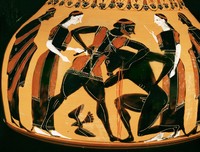
Black Figure Amphora depicting Theseus slaying the minotaur
-
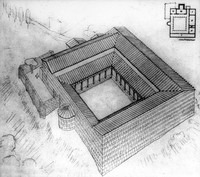
An artist's rendering of the Heroon at Kalydon
-
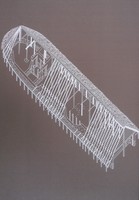
A diagram of the Toumba Complex at Lefkandi
-
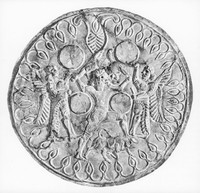
This is a bronze shield depicting Zeus surrounded by the Curetes. He is shown in composite perspective with a long beard, wearing a chiton. He has two animals (lions?) in his hands and his left foot is squashing a miniature bull. The Curetes are next to him with their shields (raised above their heads) and ropes in hand. They are also depicted in composite perspective. All of the figures appear Assyrian stylistically. The shield is outlined with bud motifs (rosettes and leaves) calling back to Archaic pottery.
-
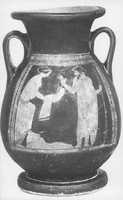
This is a terracotta, red-figure pelike (jar) illustrating the a scene from the story of the Birth of Zeus. Rhea (Zeus' mother and a Titan) is giving a baby Zeus decoy (stone wrapped in cloth) to Cronus (Zeus' father and a Titan) to eat (Cronus ate all of his children so that they would not live to overthrow him). Rhea hid Zeus from Cronos supposedly in the Idaean Cave.
-
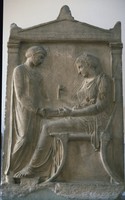
High classical grave stele portraying a domestic scene where Hegeso sits and is attended to by a servant.
-
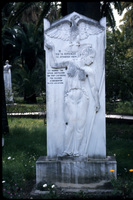
This is a monument to commemorate the support of the American people during World War II (1939). This frieze depicts a woman in composite perspective with a helmet holding a staff (her left arm is raised). There is an eagle above her. There are also 2 Greek inscriptions carved on the left side of the woman. The upper inscription reads: "The sons of Perikles of the Achepa Organization." The lower inscription reads: "In memory of the American heroes who fought for Greek freedom in 1939." This is in the Garden of Heroes in Missolonghi, which contains many monuments made commemorating the Greek War of Independence. This monument honors Americans (symbolized by the American national bird and a woman personifying liberty).
-
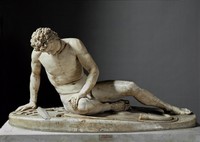
A Celtic trumpeter bleeds out. This work is a Roman marble copy of a Greek Hellenistic original.
-
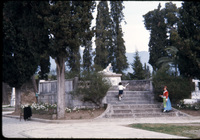
This image shows a Greek monument depicting a human form which is resting atop a pedestal, and the steps leading up to it. The image is of a young Greek girl with her hair in a knot, clutching a robe or clothing. She is sitting on top of the grave marker and is tracing the name of the deceased with her hand. Two children are present on the steps, one in traditional Greek clothing. The monument itself is surrounded by foliage and trees.
-
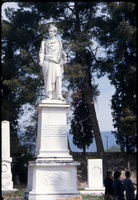
This is a memorial to Lord Byron set within a memorial garden dedicated to the heroes of Greek independence. The sculpture is highly naturalistic and set on top of a large monument with an inscription in Greek. Visitors are seen to the left.
-
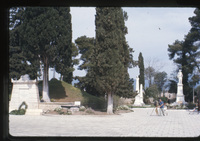
This image shows a man with a camera in the middle of a brick pathway, surrounded by cultivated greenery and several statues, including a statue of Lord Byron at the right. It appears to be a cemetery. There are several obelisk statues in the background, but the closest monument, as well as the focus of the man’s camera in the image, is a large stone trapezoid with fresh wreaths in front of it.
-
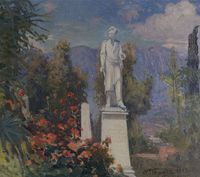
1923, oil on canvas